
Mujthaba Sulthan

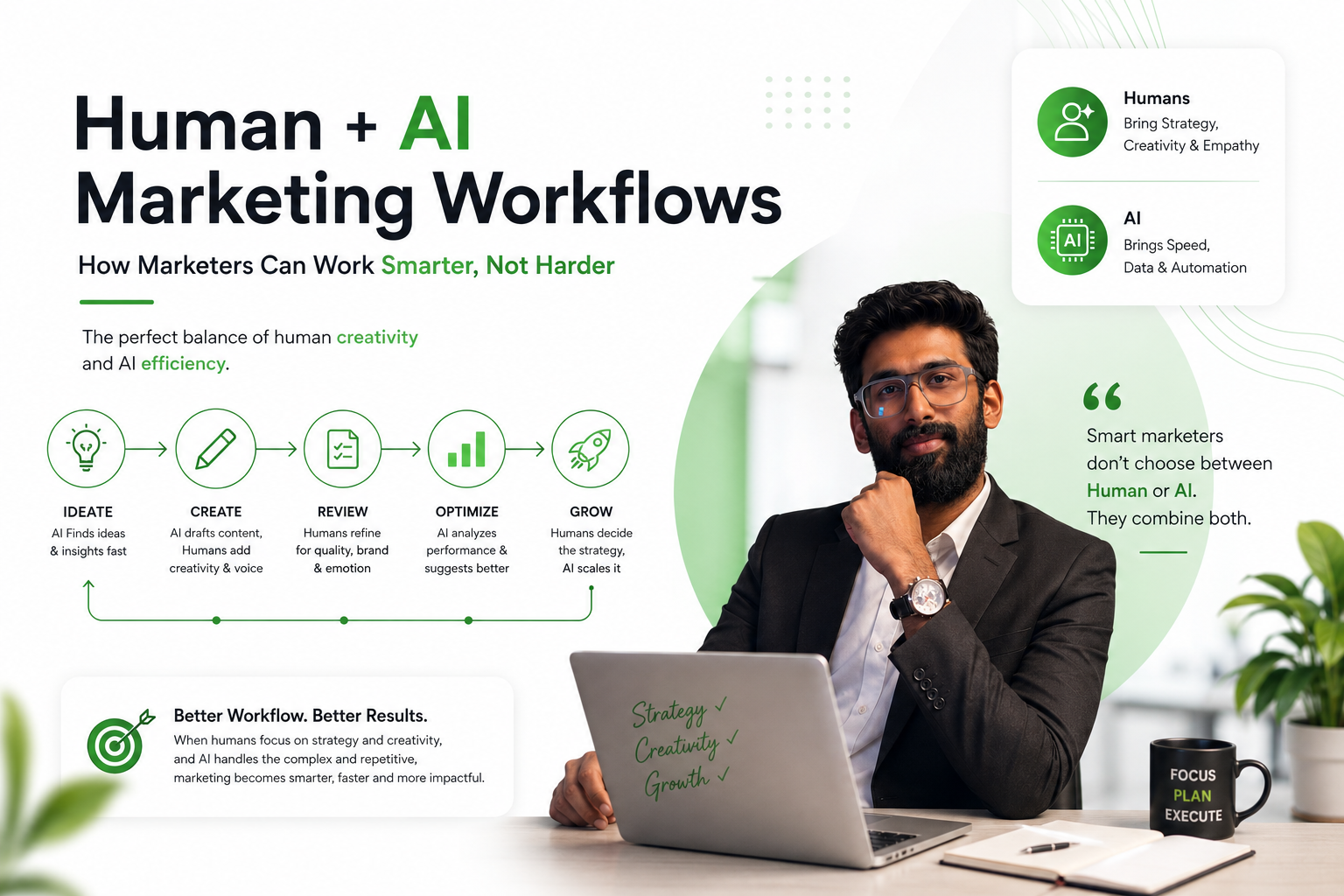
Human + AI Marketing Workflows: How Marketers Can Work Smarter, Not Harder

Human + AI marketing workflows

Introduction

Artificial intelligence is changing the way marketers research, create, analyze, and optimize campaigns. But AI is not necessarily replacing marketers. Instead, the biggest opportunity lies in combining human creativity and strategic thinking with AI’s speed and processing power.

This is where Human + AI marketing workflows come into play.

A well-designed workflow allows AI to handle repetitive and data-heavy tasks while humans remain responsible for creativity, judgment, brand voice, emotional understanding, and strategic decisions.

The result? Faster execution, better efficiency, and more time for marketers to focus on ideas that actually make an impact.

What Are Human + AI Marketing Workflows?
Human + AI marketing workflows

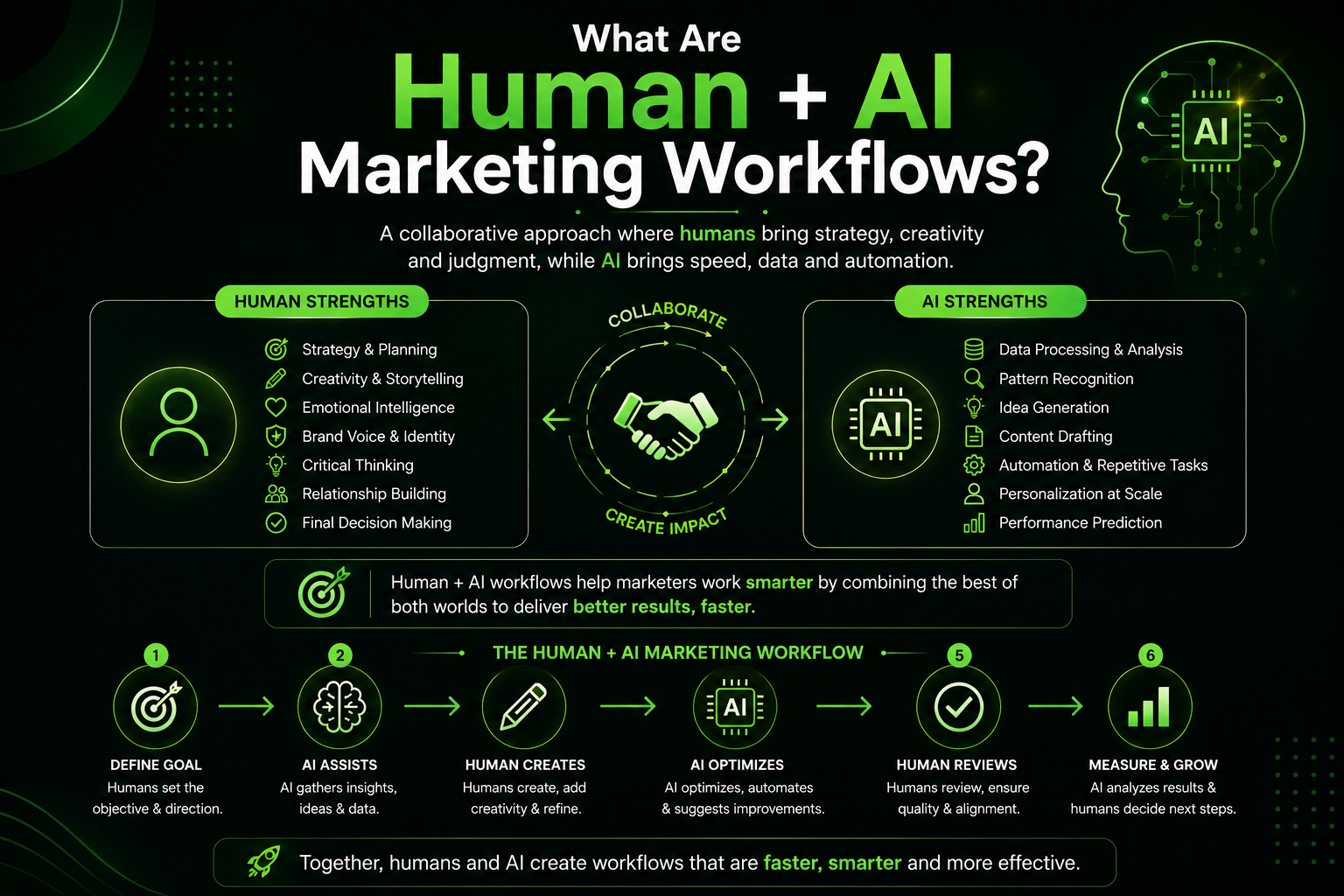
Human + AI marketing workflows are structured processes where humans and AI work together to complete marketing tasks.

Instead of asking AI to do everything, marketers divide responsibilities according to strengths.

AI is good at:

  • Processing large amounts of information

  • Finding patterns

  • Generating ideas

  • Analyzing data

  • Automating repetitive tasks

  • Creating first drafts

  • Personalizing content

Humans are good at:

  • Understanding emotions

  • Making strategic decisions

  • Building relationships

  • Understanding cultural context

  • Creating original concepts

  • Maintaining brand identity

  • Evaluating quality and ethics

The workflow becomes:

Human Strategy → AI Assistance → Human Review → AI Optimization → Human Decision

This creates a more balanced approach to modern marketing.

Why Human + AI Marketing Workflows Matter
Human + AI marketing workflows

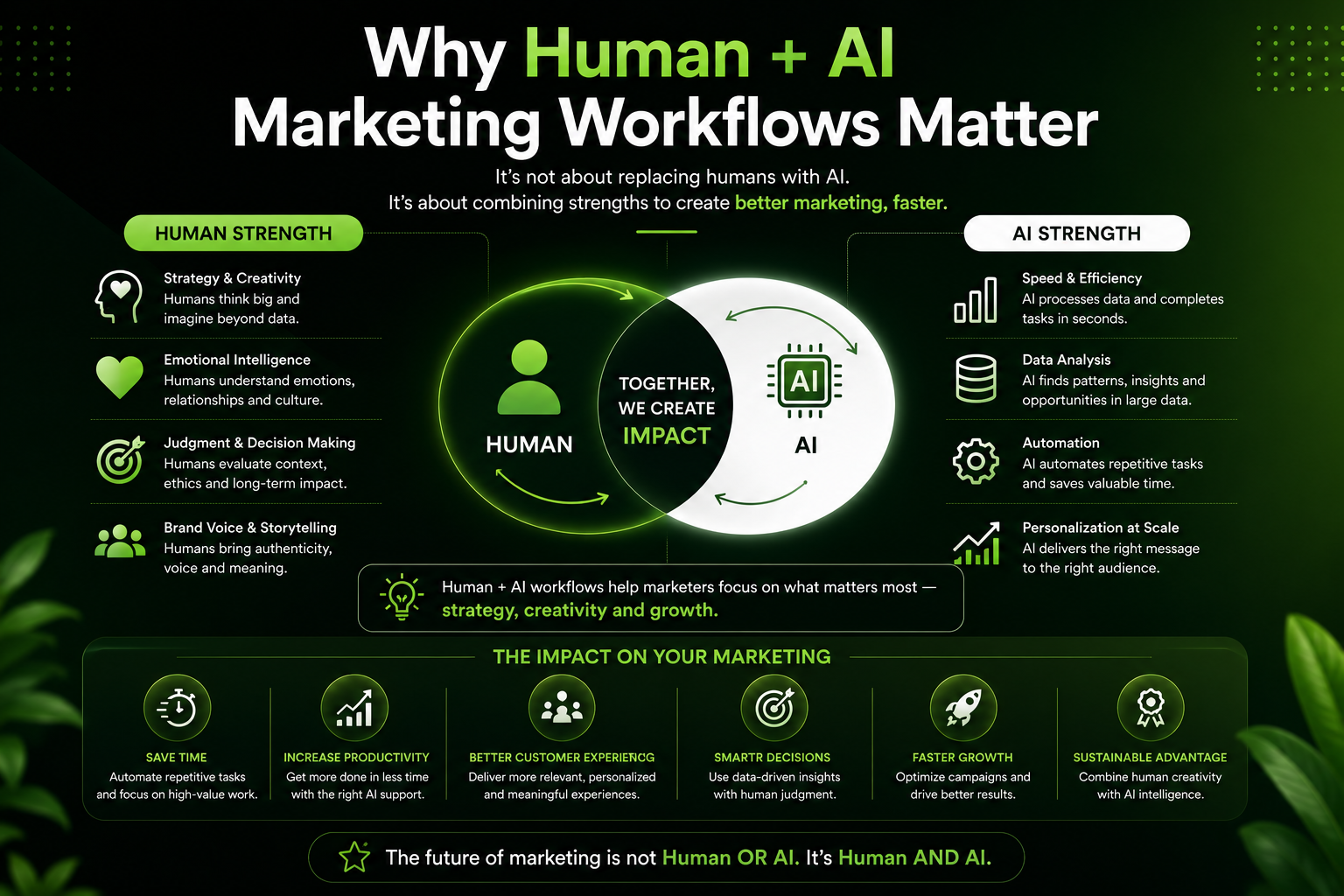
Traditional marketing often requires marketers to spend hours researching competitors, creating content, analyzing performance, and preparing reports.

AI can significantly reduce the time required for many of these tasks.

For example, a marketer could spend three hours researching content ideas. An AI tool can help organize hundreds of potential ideas within minutes.

However, speed alone doesn’t guarantee good marketing.

AI may generate technically correct content that feels generic or fails to understand the audience. That’s why human involvement remains essential.

The goal isn’t:

“AI does the marketing.”

The better approach is:

“AI helps marketers do better marketing.”

1. Research: Let AI Find the Patterns

The first stage of an AI marketing workflow can involve research.

AI can help marketers analyze:

  • Customer reviews

  • Search queries

  • Competitor content

  • Social media conversations

  • Market trends

  • Frequently asked questions

  • Audience interests

For example, imagine you’re marketing a fitness brand.

Instead of manually analyzing hundreds of comments, AI can help identify recurring concerns such as:

“I don’t have time to exercise.”

The marketer can then turn that insight into a campaign around quick workouts for busy professionals.

AI finds the pattern.

The marketer finds the opportunity.

2. Content Creation: AI as a Creative Assistant

Content creation is one of the most common applications of AI in digital marketing.

AI can help generate:

  • Blog ideas

  • Social media captions

  • Video concepts

  • Headlines

  • Ad variations

  • Email drafts

  • Content outlines

  • SEO topic clusters

But marketers shouldn’t simply copy and publish AI-generated content.

A stronger human + AI marketing workflow looks like this:

Human: Defines audience and campaign objective

AI: Generates ideas and initial drafts

Human: Adds experience, personality and brand voice

AI: Helps optimize structure and variations

Human: Final review and approval

This keeps the content efficient without making it feel robotic.

3. Personalization at Scale

Personalization has always been powerful, but doing it manually for thousands of customers is extremely difficult.

AI makes large-scale personalization more practical.

For example, an e-commerce company could create different customer segments based on:

  • Previous purchases

  • Browsing behavior

  • Interests

  • Location

  • Engagement

  • Purchase frequency

AI can help identify these patterns and recommend relevant messages.

Instead of sending one generic email to everyone, marketers can create different experiences for different customer groups.

One strategy. Thousands of personalized experiences.

4. AI-Powered Marketing Analytics

Another major advantage of AI is data analysis.

Modern marketing generates enormous amounts of data from websites, social media, advertisements, email campaigns, and customer interactions.

AI can help marketers identify:

  • Which campaigns perform best

  • Which audiences convert

  • Where customers drop off

  • Which content generates engagement

  • Which channels provide better results

  • Potential changes in customer behavior

But analytics shouldn’t be completely automated.

AI can identify a pattern, but a human needs to ask:

“Why is this happening?”

That question often requires business knowledge, customer understanding, and context.

5. Human Creativity Still Matters

One of the biggest misconceptions about AI marketing is that creativity can be completely automated.

AI can generate thousands of ideas.

But more ideas don’t automatically mean better ideas.

A human marketer understands:

  • What the brand stands for

  • What the audience feels

  • What cultural references work

  • What emotions should be communicated

  • What makes the brand different

AI can provide possibilities.

Humans provide meaning.

That’s why human creativity remains one of the most important parts of an effective AI marketing strategy.

6. Building an Effective Human + AI Workflow

A practical workflow can follow five steps:

Step 1: Define the Objective

Start with a clear goal.

For example:

Goal: Increase qualified leads by 20%.

Don’t start with the AI tool. Start with the business objective.

Step 2: Give AI the Right Context

AI performs better when marketers provide useful information such as:

  • Target audience

  • Brand voice

  • Product details

  • Customer pain points

  • Campaign goals

  • Competitor positioning

Better input generally leads to better output.

Step 3: Let AI Handle Repetitive Work

Use AI for tasks such as:

  • Research organization

  • Data analysis

  • Idea generation

  • Draft creation

  • Content variations

  • Reporting

  • Workflow automation

This allows marketers to spend more time on strategic work.

Step 4: Apply Human Judgment

Never remove human review from important marketing decisions.

Check:

  • Accuracy

  • Brand consistency

  • Originality

  • Emotional impact

  • Cultural sensitivity

  • Ethical concerns

Step 5: Optimize Based on Real Results

After publishing a campaign, analyze the actual performance.

AI can help identify patterns, but marketers should decide what changes should be made.

This creates a continuous cycle:

Plan → AI Assist → Create → Human Review → Launch → Analyze → Optimize

The Future of Human + AI Marketing
Human + AI marketing workflows

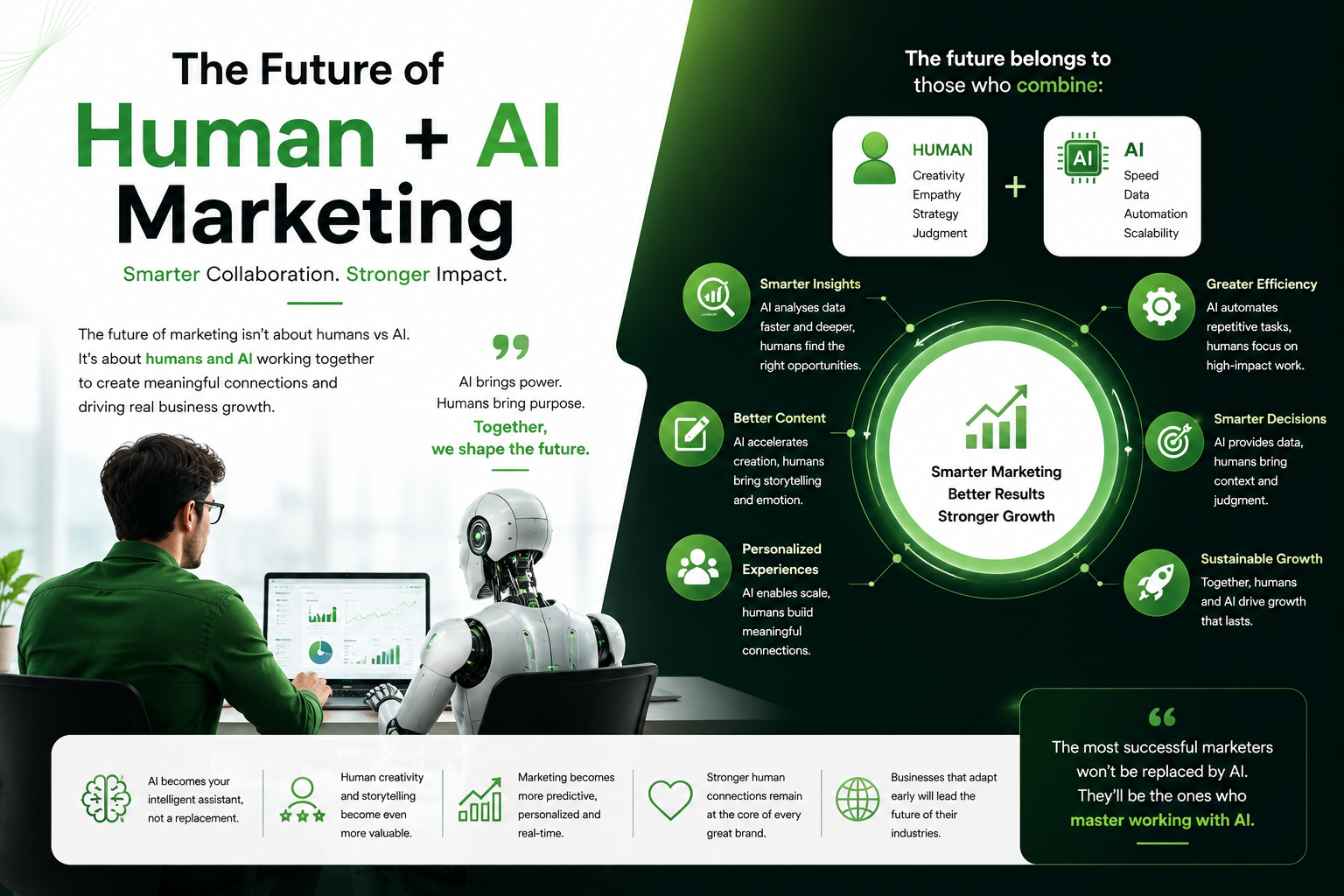
The future of marketing is not about humans competing with artificial intelligence. It is about humans and AI working together to create smarter, faster, and more meaningful marketing.

AI can process huge amounts of data, identify customer patterns, automate repetitive tasks, generate ideas, and personalize marketing campaigns. However, AI does not truly understand human emotions, cultural context, relationships, or the deeper meaning behind a brand. This is where human marketers remain essential.

AI Brings Speed & Intelligence

AI can help marketers:

  • Analyze customer and market data

  • Identify trends and patterns

  • Generate content ideas

  • Automate repetitive marketing tasks

  • Personalize customer experiences

  • Predict customer behavior

  • Analyze campaign performance

  • Create multiple versions of ads and content

Instead of spending hours on repetitive tasks, marketers can use AI to work faster and focus on higher-value activities.

Humans Bring Creativity & Strategy

Human marketers contribute things that technology cannot easily replace:

  • Creativity

  • Emotional intelligence

  • Strategic thinking

  • Storytelling

  • Brand identity

  • Cultural understanding

  • Critical decision-making

  • Human relationships

A campaign might have excellent data behind it, but without a strong human idea or emotional connection, it may fail to connect with the audience.

 The Future Is Collaboration

The most effective approach is to combine the strengths of both.

Human → Strategy & Vision

AI → Research & Data Analysis

Human → Creativity & Decision Making

AI → Automation & Optimization

Human → Review & Final Direction

This creates a marketing system where AI handles speed and scale, while humans provide meaning and direction.

What Will Marketing Look Like?

In the future, marketers will increasingly use AI as an intelligent assistant rather than simply a content-generation tool.

For example, an AI system could analyze thousands of customer interactions and identify a new audience trend. The marketer can then use that insight to create a campaign based on a genuine human idea. AI can help produce different versions of the campaign, personalize them for different audiences, and monitor performance.

The human marketer remains responsible for deciding what the brand should say, why it should say it, and how it should make people feel.

The Biggest Opportunity

The marketers who benefit most from AI will not necessarily be those who use the most AI tools.

They will be the ones who know how to combine technology with creativity, strategy, psychology, and human understanding.

AI can make marketing faster.

Humans can make it meaningful.

Together, they can make it more powerful.

The future of marketing isn’t Human vs AI.
It’s Human + AI.

AI for Customer Journey Mapping

Human + AI marketing workflows can make customer journey mapping more efficient by combining AI-powered behavioral analysis with human understanding of customer needs.

AI can analyze website visits, search behavior, social media engagement, email interactions, and purchase history to identify patterns in the customer journey.

For example, AI may identify that customers who read a particular blog post are more likely to visit a pricing page. Marketers can use this insight to create better content and guide customers toward the next stage of their journey.

AI maps the journey. Humans improve the experience.


Predictive Marketing With Human + AI Marketing Workflows

Traditional marketing often focuses on what customers have already done. Human + AI marketing workflows allow marketers to use predictive insights to anticipate what customers may do next.

AI can analyze historical customer behavior and identify people who may be ready to purchase, stop engaging, or respond positively to a particular offer.

However, AI predictions should not automatically determine marketing decisions. Human marketers need to consider business goals, customer expectations, and market conditions before taking action.


AI-Powered A/B Testing

A/B testing becomes more efficient when included in Human + AI marketing workflows.

AI can generate different versions of headlines, advertisements, landing pages, email subject lines, and calls to action. It can also help analyze performance and identify patterns more quickly.

The human marketer then evaluates whether the winning version actually supports the campaign objective.

AI finds the performance difference. Humans understand the reason behind it.


Human + AI Marketing Workflows for Social Media Marketing

Social media marketing requires constant content creation, audience monitoring, trend identification, and performance analysis.

A strong Human + AI marketing workflow can help marketers generate content ideas, create initial captions, repurpose existing content, identify engagement patterns, and develop multiple content variations.

For example, one long-form blog can become:

  • Instagram posts
  • LinkedIn content
  • Short-video ideas
  • Carousel posts
  • Email content
  • Social media captions

The human marketer then adds personality, creativity, cultural context, and brand identity.

AI provides speed. Humans provide personality.


Human + AI Marketing Workflows for SEO

SEO is another area where Human + AI marketing workflows can improve efficiency.

AI can help marketers identify search intent, related topics, content gaps, keyword clusters, frequently asked questions, and internal linking opportunities.

However, marketers should avoid simply publishing large quantities of generic AI-generated content.

Human expertise remains important for adding:

  • Original insights
  • Real examples
  • Industry knowledge
  • Personal experience
  • Expert opinions
  • Useful explanations

AI can accelerate SEO research, but humans create valuable content.


AI-Powered Customer Feedback Analysis

Customer feedback is an important part of Human + AI marketing workflows.

AI can analyze customer reviews, comments, surveys, and support messages to identify common complaints, product requests, positive experiences, and recurring problems.

For example, if hundreds of customers mention slow delivery, AI can identify the recurring pattern. A marketer can then investigate the reason and develop a communication or campaign strategy around the issue.

This transforms customer feedback into actionable marketing insights.


AI for Competitive Intelligence

Human + AI marketing workflows can also improve competitive research.

AI can help marketers analyze competitor content, advertising messages, product positioning, customer reviews, and social media activity.

The objective is not to copy competitors.

Instead, marketers can use AI-generated insights to discover gaps and identify opportunities to differentiate their brand.

AI finds competitive patterns. Humans turn them into strategy.


Building a Brand Voice With Human + AI Marketing Workflows

One challenge with AI-generated content is that different brands can start sounding similar.

A strong Human + AI marketing workflow should therefore include clear brand voice guidelines.

Marketers can define:

  • Brand personality
  • Tone
  • Vocabulary
  • Communication style
  • Audience preferences
  • Emotional direction

AI can then assist with content generation while humans review the output to ensure it sounds authentic to the brand.


Human + AI Marketing Workflows for Lead Scoring

Not every lead has the same level of buying intent.

AI can analyze behavioral signals such as website visits, content downloads, email engagement, product-page views, and demo requests.

Within Human + AI marketing workflows, AI can identify high-intent leads while marketers decide how those leads should be approached.

This helps sales and marketing teams focus their time on opportunities with greater potential.


AI-Powered Marketing Automation

Marketing automation becomes significantly more useful when combined with Human + AI marketing workflows.

For example:

Website Visit → Interest Detection → Personalized Content → Engagement → Lead Scoring → Sales Follow-Up

AI can identify customer interests while automation triggers appropriate actions.

Humans remain responsible for designing the strategy, defining customer journeys, and deciding how automated communication should work.


Human Oversight in Human + AI Marketing Workflows

Human oversight is one of the most important elements of Human + AI marketing workflows.

AI-generated marketing content should be reviewed for:

  • Accuracy
  • Brand consistency
  • Originality
  • Bias
  • Privacy
  • Cultural sensitivity
  • Ethical concerns
  • Misleading claims

AI can assist marketers, but humans should remain accountable for important decisions.


Measuring Human + AI Marketing Workflows

The success of Human + AI marketing workflows should not be measured by how many AI tools a marketer uses.

Instead, marketers should measure real business outcomes such as:

  • Conversion rate
  • Customer acquisition cost
  • Return on ad spend
  • Lead quality
  • Customer retention
  • Engagement
  • Revenue
  • Customer lifetime value

The important question is:

Did Human + AI marketing workflows help us achieve better marketing results?


A Complete Human + AI Marketing Workflow

An effective Human + AI marketing workflow can connect human thinking and AI assistance across the entire marketing process:

Human defines the objective

AI researches and analyzes information

Human identifies the key insight

AI generates possible ideas

Human selects the strongest concept

AI assists with content creation

Human reviews and improves the output

AI analyzes campaign performance

Human makes strategic decisions

AI assists with optimization

This creates a continuous marketing cycle:

Strategy → Research → Creation → Review → Launch → Analysis → Optimization


Human + AI Marketing Workflows as a Competitive Advantage

Access to AI tools alone is no longer enough. The real advantage comes from knowing how to integrate those tools into effective Human + AI marketing workflows.

Two marketers can use the same AI tool and still produce completely different results.

The difference comes from:

  • Strategy
  • Customer understanding
  • Creative direction
  • Prompt quality
  • Brand knowledge
  • Human judgment

The future advantage belongs to marketers who know how to orchestrate AI rather than simply use AI.


The Future of Human + AI Marketing Workflows

The future of marketing will increasingly combine AI, automation, behavioral data, creativity, and human strategy.

Human + AI marketing workflows will allow marketers to analyze information faster, personalize customer experiences, automate repetitive processes, and explore more creative possibilities.

But technology alone will not create great marketing.

Successful marketers will need to understand people, technology, and strategy—and know how to connect all three.https://www.marketermilk.com/blog/ai-marketing-workflow


Conclusion

Human + AI marketing workflows represent a shift from using AI as a simple content-generation tool to using it as a strategic marketing partner.

AI brings speed, scale, automation, data analysis, and multiple possibilities.

Humans bring strategy, creativity, empathy, judgment, context, and brand understanding.

When these strengths are combined, Human + AI marketing workflows can help businesses create faster, more scalable, personalized, and data-driven marketing without losing the human element.

AI brings speed and scale.
Humans bring meaning and direction.
Together, they create smarter marketing.


Leave a Reply

Your email address will not be published. Required fields are marked *