
Introduction
Why does a customer choose one brand over another when both products offer almost the same features?
Why do people buy something they never planned to purchase?
Why does a limited-time offer suddenly make a product feel more valuable?
And why do some advertisements stay in our minds while others are forgotten within seconds?
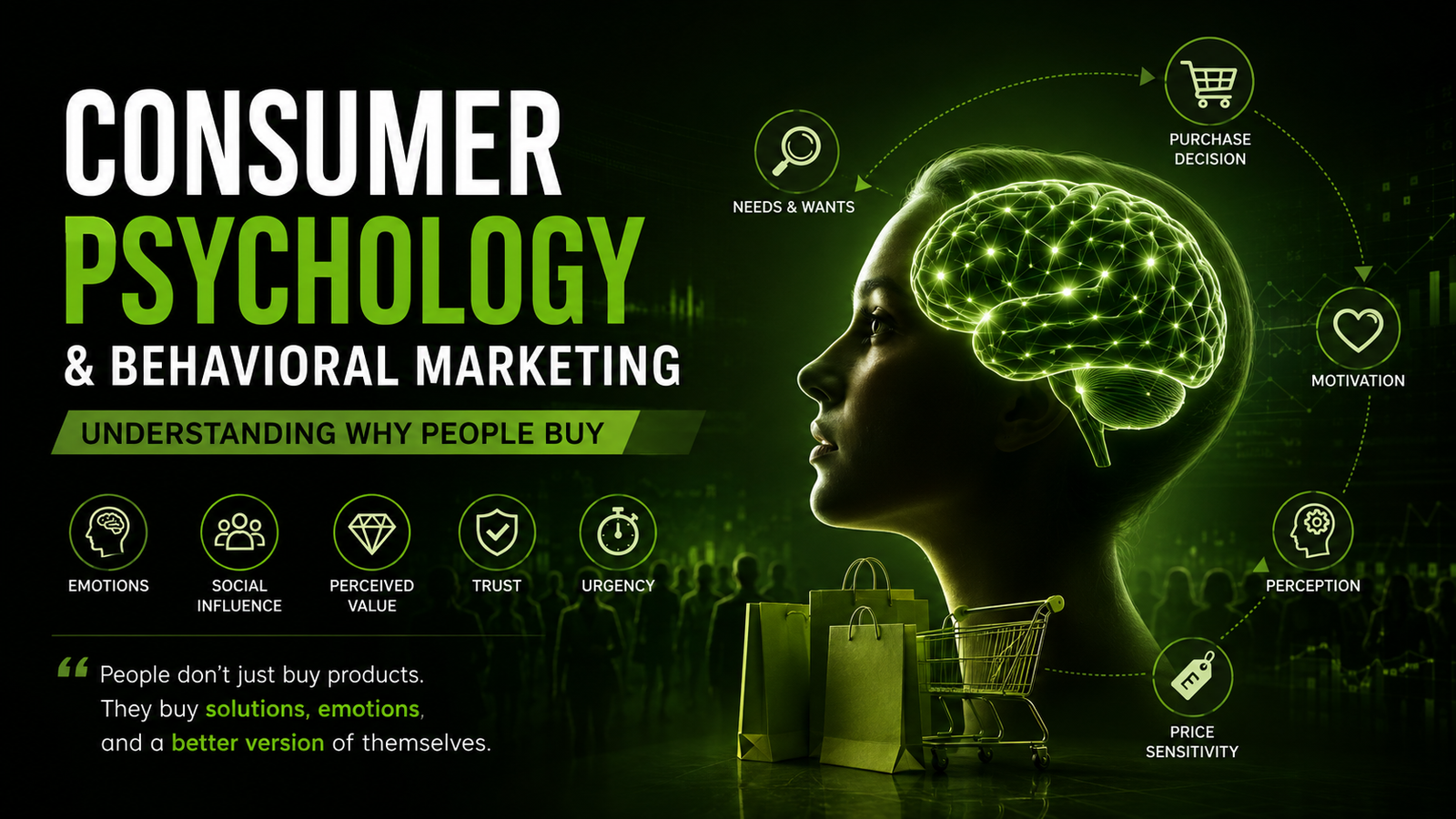
The answer is not always price, quality, or product features. A major part of the answer lies in Consumer Psychology & Behavioral Marketing.
Marketing is ultimately about people. Before customers become buyers, they think, feel, compare, evaluate, hesitate, and make decisions. Understanding these psychological and behavioral processes allows marketers to create campaigns that connect with customers at a deeper level.
Consumer psychology focuses on how people’s thoughts, emotions, perceptions, motivations, and beliefs influence their purchasing decisions. Behavioral marketing takes these insights and uses actual customer behaviors—such as browsing, clicking, purchasing, searching, and engaging—to create more relevant marketing experiences.
When combined, these approaches help brands move beyond simply asking:
“What does the customer want?”
Instead, marketers can ask:
“Why does the customer want it, and what influences the decision?”
What Is Consumer Psychology?
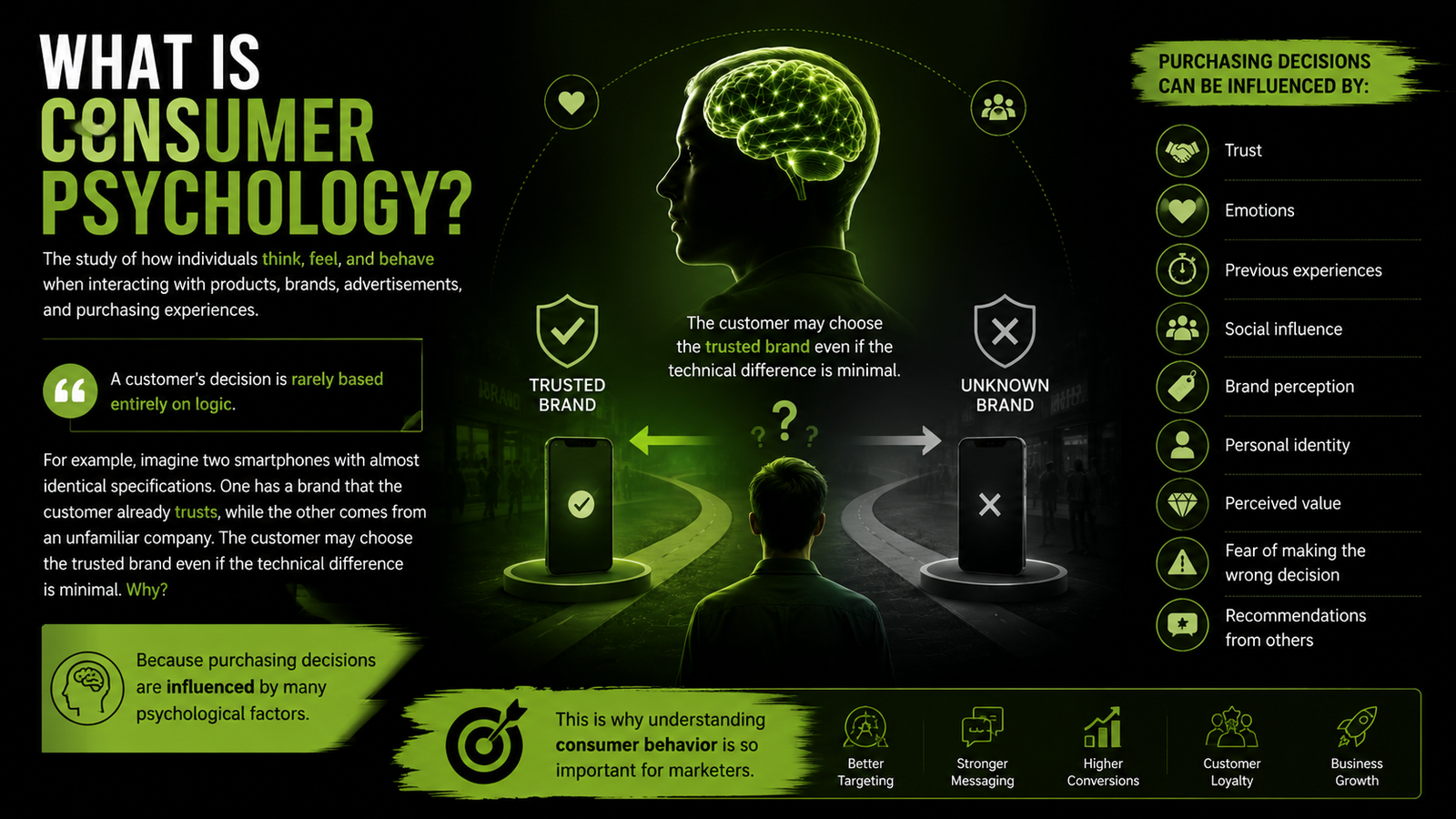
Consumer psychology is the study of how individuals think, feel, and behave when interacting with products, brands, advertisements, and purchasing experiences.
A customer’s decision is rarely based entirely on logic.
For example, imagine two smartphones with almost identical technical specifications. One has a brand that the customer already trusts, while the other comes from an unfamiliar company.
The customer may choose the trusted brand even if the technical difference is minimal.
Why?
Because purchasing decisions can be influenced by:
- Trust
- Emotions
- Previous experiences
- Social influence
- Brand perception
- Personal identity
- Perceived value
- Fear of making the wrong decision
- Recommendations from others
This is why understanding consumer behavior is so important for marketers.
What Is Behavioral Marketing?
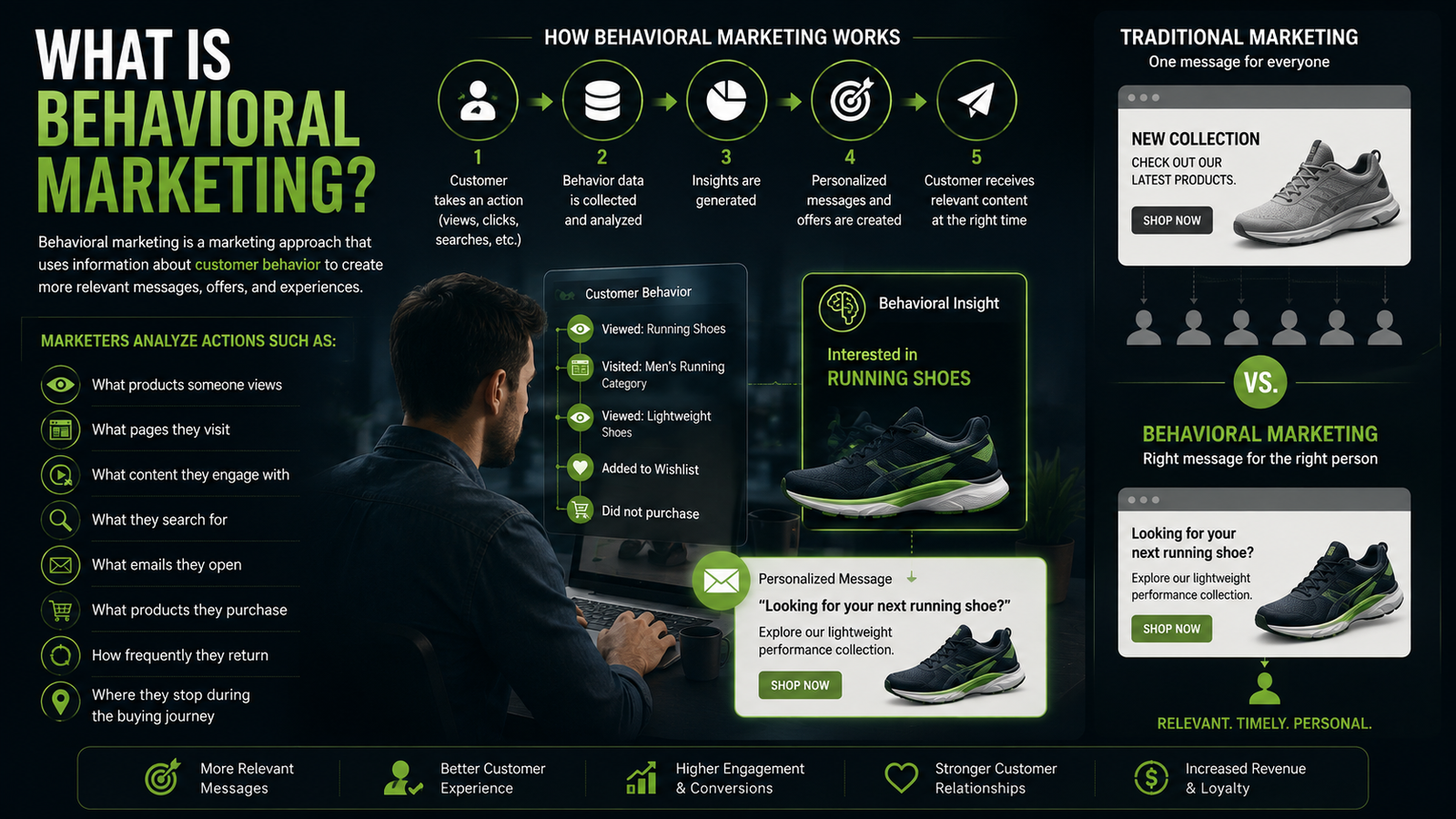
Behavioral marketing is a marketing approach that uses information about customer behavior to create more relevant messages, offers, and experiences.
Instead of treating every customer the same, marketers can analyze actions such as:
- What products someone views
- What pages they visit
- What content they engage with
- What they search for
- What emails they open
- What products they purchase
- How frequently they return
- Where they stop during the buying journey
For example, imagine someone visits an online shoe store and repeatedly views running shoes but doesn’t purchase.
A traditional marketing strategy might show the same advertisement to everyone.
A behavioral marketing strategy could recognize the person’s interest in running shoes and show them relevant content, such as:
“Looking for your next running shoe? Explore our lightweight performance collection.”
The message becomes more relevant because it is connected to actual behavior.
Consumer Psychology + Behavioral Marketing: Why They Work Together
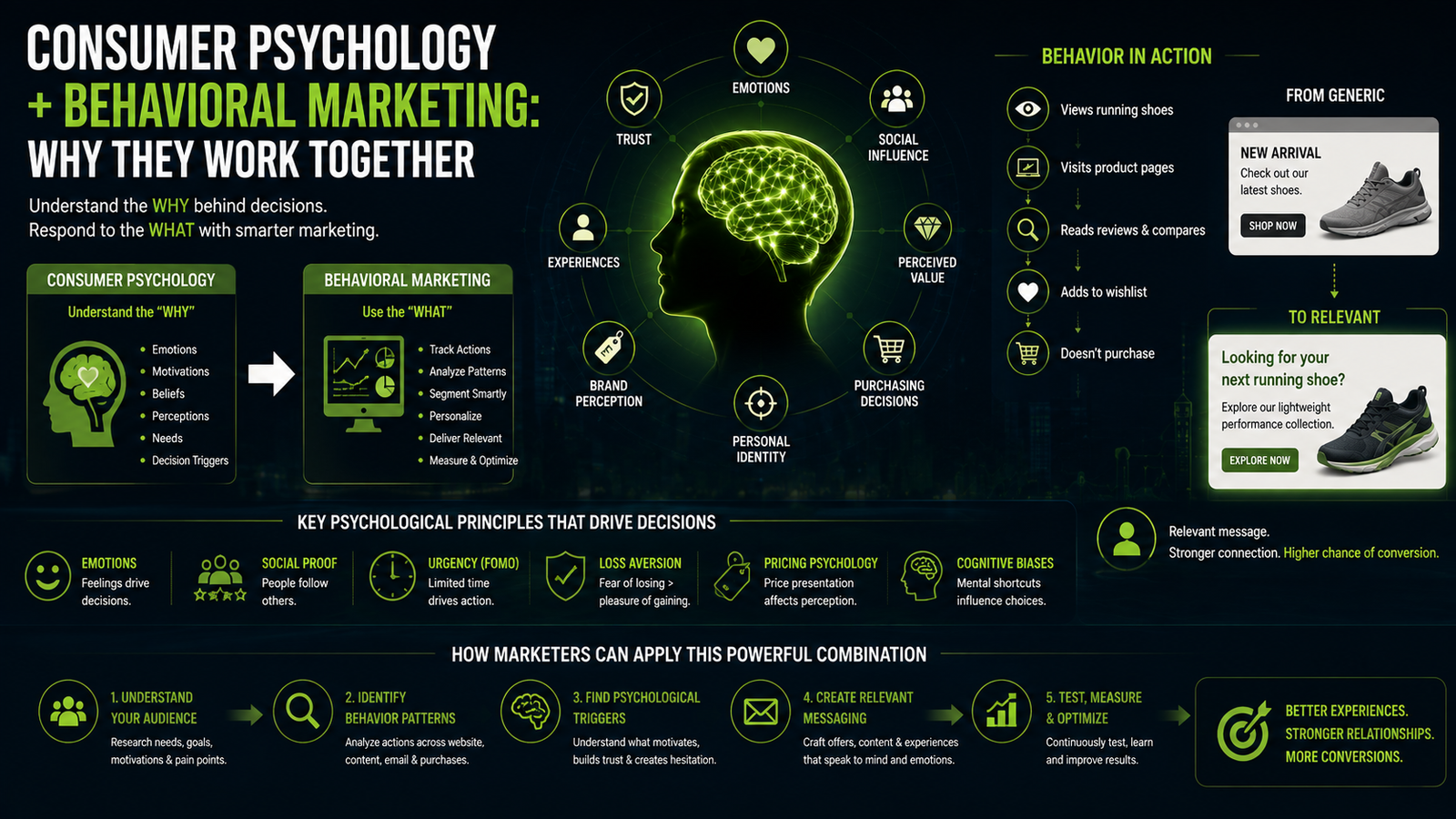
Consumer psychology explains why people behave in certain ways.
Behavioral marketing helps marketers respond to those behaviors.
Think of it this way:
Consumer Psychology → Understand the “Why”
Behavioral Marketing → Use the “What”
For example, consumer psychology may tell us that people often look for reassurance before making an expensive purchase.
Behavioral marketing can identify customers who repeatedly visit product pages, read reviews, and compare pricing.
The brand can then provide:
- Customer testimonials
- Product demonstrations
- Reviews
- Guarantees
- FAQs
- Comparison guides
This creates a marketing experience designed around both psychological needs and observable behavior.
1. Emotions Influence Buying Decisions
One of the most powerful concepts in marketing psychology is emotion.
Customers don’t always buy products simply because they need them. They may buy because a product makes them feel:
- Confident
- Secure
- Successful
- Attractive
- Comfortable
- Excited
- Accepted
- Independent
Consider luxury brands.
A luxury watch doesn’t simply tell customers the time. The marketing may communicate ideas such as achievement, status, exclusivity, and personal success.
Similarly, a fitness brand may not simply sell exercise equipment. It may sell the feeling of confidence and transformation.
This is known as emotional marketing.
A strong marketer doesn’t only communicate:
“Here are our product features.”
They communicate:
“Here is how this product can improve your life.”
2. The Power of Social Proof
People often look at the behavior of others when making decisions.
This is known as social proof.
When customers see that other people have purchased, reviewed, recommended, or used a product, they may feel more confident about their own decision.
Examples include:
- Customer reviews
- Testimonials
- Ratings
- Case studies
- User-generated content
- Influencer recommendations
- Customer numbers
- Social media engagement
Imagine two restaurants.
Restaurant A has no reviews displayed.
Restaurant B has thousands of positive reviews and photographs from customers.
Even if both restaurants offer similar food, Restaurant B may appear more trustworthy.
This is because customers are using the experiences of other people as a signal when evaluating their own decision.
3. FOMO and the Psychology of Urgency
FOMO, or the fear of missing out, is another psychological principle commonly used in marketing.
Messages such as:
- “Limited-time offer”
- “Only a few seats remaining”
- “Sale ends tonight”
- “Early-bird pricing”
- “Last chance”
create a sense of urgency.
When people believe an opportunity may disappear, they may be more motivated to act.
However, marketers need to use urgency responsibly.
Artificial scarcity or misleading countdown timers can damage trust.
Effective behavioral marketing should create urgency without manipulating customers through false information.
4. Loss Aversion: Why People Hate Losing More Than They Like Winning
Another important principle in consumer psychology is loss aversion.
People often perceive the pain of losing something as stronger than the pleasure of gaining something of equal value.
Marketing can communicate this difference.
Compare:
“Save ₹1,000 today.”
with:
“Don’t lose your ₹1,000 savings—offer ends tonight.”
Both communicate a similar financial benefit, but the second message frames the decision around avoiding a loss.
This doesn’t mean marketers should scare customers.
Instead, understanding loss aversion helps marketers understand how the framing of information can influence consumer decision-making.
5. The Psychology of Pricing
Price is more than a number.
The way a price is presented can influence how customers perceive value.
For example:
₹999
may feel psychologically different from:
₹1,000
even though the difference is only ₹1.
Similarly, presenting multiple pricing options can influence which option customers choose.
For example:
Basic — ₹499
Professional — ₹999
Premium — ₹1,499
If the middle option is positioned as the “most popular,” customers may perceive it as a balanced choice.
This is one reason pricing psychology is an important part of behavioral marketing.
The objective shouldn’t be to trick customers. Instead, pricing should make the value and differences between options clear.
6. The Role of Cognitive Biases
Human decision-making is influenced by many cognitive biases.
A cognitive bias is a mental shortcut or tendency that can influence how people interpret information and make decisions.
Some commonly discussed examples in marketing include:
Anchoring Bias
People may rely heavily on the first number or piece of information they see.
For example:
Original Price: ₹5,000
Offer Price: ₹2,999
The original price can act as an anchor that affects how the customer perceives the discounted price.
Confirmation Bias
People tend to look for information that supports what they already believe.
Choice Overload
Too many options can make decision-making more difficult.
Bandwagon Effect
People may be influenced by the perception that many others are choosing something.
Understanding these tendencies can help marketers design clearer and more effective customer experiences.
7. Personalization and Behavioral Segmentation
Not every customer has the same needs.
A 20-year-old student and a 40-year-old business owner may interact with the same brand differently.
This is where behavioral segmentation becomes valuable.
Customers can be grouped based on behaviors such as:
- First-time visitors
- Returning visitors
- Frequent buyers
- High-value customers
- Cart abandoners
- Highly engaged users
- Inactive customers
- Product-specific visitors
Each group can receive different messages.
For example:
First-time visitor:
“New here? Explore our best-selling products.”
Returning visitor:
“Welcome back. Here’s what’s new.”
Cart abandoner:
“Still thinking about it? Your selected items are waiting.”
This makes marketing more relevant without treating every customer identically.
8. The Customer Journey and Decision-Making
A customer rarely moves directly from seeing an advertisement to making a purchase.
The journey often looks like:
Awareness → Interest → Consideration → Evaluation → Purchase → Experience → Loyalty
Each stage involves different psychological questions.
Awareness
“What is this?”
Interest
“Could this help me?”
Consideration
“Is it better than the alternatives?”
Evaluation
“Can I trust this brand?”
Purchase
“Should I buy it now?”
Experience
“Was this worth it?”
Loyalty
“Would I choose this brand again?”
A strong behavioral marketing strategy creates content and experiences for different stages of this journey.
9. Storytelling and Identity
People don’t always connect with brands because of products.
They connect because of stories and identity.
A brand can become part of how customers see themselves.
For example, a sustainable fashion brand may attract customers who want their purchases to reflect environmental values.
A performance-focused sports brand may attract customers who identify with ambition, discipline, and achievement.
This is why brand storytelling is powerful.
Instead of saying:
“We sell high-quality products.”
a brand can communicate:
“We help ambitious people perform at their best.”
The second message creates an identity around the product.
10. Behavioral Marketing in Social Media
Social media platforms generate enormous amounts of behavioral signals.
Users:
- Like posts
- Save content
- Share videos
- Comment
- Follow accounts
- Watch videos
- Search topics
- Visit profiles
- Click links
These actions reveal interests and preferences.
For marketers, this creates opportunities to understand what content resonates with specific audiences.
For example, if an audience repeatedly saves educational posts, a brand may create more:
- Tutorials
- Checklists
- Guides
- Educational carousels
- How-to videos
The key is not simply collecting data.
The real value comes from turning behavioral signals into better customer experiences.
11. Behavioral Marketing and AI
Artificial intelligence is making behavioral marketing more sophisticated.
AI can analyze large amounts of customer data and identify patterns that may be difficult to detect manually.
AI-powered systems can help marketers with:
- Customer segmentation
- Predictive analytics
- Recommendation systems
- Personalized content
- Customer journey analysis
- Churn prediction
- Campaign optimization
- Automated messaging
For example, an e-commerce platform can analyze previous purchases and browsing behavior to recommend products that may be relevant to a customer.
However, marketers should remember that customer data comes with responsibility.
Personalization should feel helpful—not invasive.
Transparency, consent, privacy, and responsible data use should remain important parts of modern behavioral marketing.
12. How Marketers Can Apply Consumer Psychology
Understanding psychology is useful, but applying it strategically is even more important.
Here is a practical framework:
Step 1: Understand Your Audience
Research:
- Needs
- Problems
- Goals
- Motivations
- Objections
- Preferences
Step 2: Identify Behavioral Patterns
Look at:
- Website activity
- Content engagement
- Search behavior
- Purchases
- Customer feedback
Step 3: Identify Psychological Triggers
Ask:
- What motivates this audience?
- What creates trust?
- What creates hesitation?
- What emotions influence their decision?
Step 4: Create Relevant Messaging
Use your insights to create:
- Headlines
- Advertisements
- Content
- Offers
- Landing pages
- Emails
Step 5: Test and Learn
Marketing is not a one-time psychological experiment.
Test different:
- Headlines
- Images
- Offers
- Calls to action
- Pricing presentations
- Content formats
Then analyze actual customer behavior.
Common Mistakes in Consumer Psychology & Behavioral Marketing
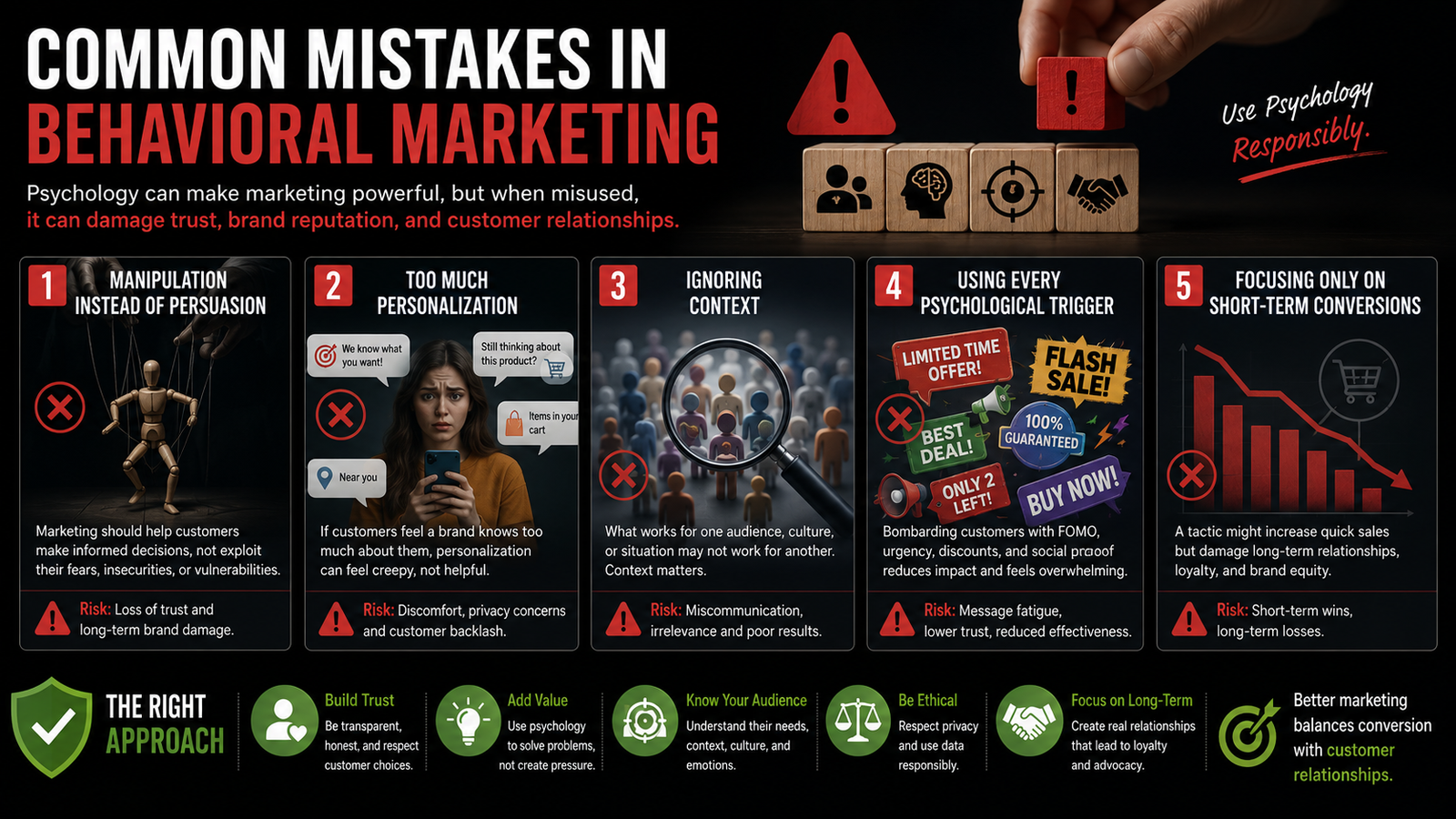
While Consumer Psychology & Behavioral Marketing can make marketing more effective and persuasive, these powerful techniques can also be misused. Understanding these common mistakes helps marketers create better, smarter, and more trustworthy customer experiences.
Manipulation Instead of Persuasion
Consumer Psychology & Behavioral Marketing should help customers make informed decisions rather than exploit their vulnerabilities. Ethical persuasion builds positive customer experiences and long-term trust.
Too Much Personalization
Personalization can create better and more relevant experiences, but excessive personalization may make customers uncomfortable if they feel a brand knows too much about them.
Ignoring Context
A psychological principle that produces excellent results for one audience may not work for another. Successful Consumer Psychology & Behavioral Marketing requires understanding the audience, industry, culture, and situation.
Using Every Psychological Trigger
Not every campaign needs FOMO, urgency, discounts, and social proof simultaneously. A smart and effective marketing strategy uses the right psychological principle at the right time.
Focusing Only on Short-Term Conversions
A tactic might increase immediate sales while damaging long-term trust. The best Consumer Psychology & Behavioral Marketing strategy balances conversions with strong customer relationships, loyalty, and sustainable growth.
The Positive Future of Consumer Psychology & Behavioral Marketing
The future of Consumer Psychology & Behavioral Marketing is becoming increasingly powerful, personalized, and data-driven.
AI, predictive analytics, automation, and behavioral data will help brands understand customers at a greater scale. These technologies can create better experiences, smarter campaigns, and stronger customer relationships.
However, technology alone will not create great marketing.
People still want:
- Trust
- Authenticity
- Relevance
- Emotional connection
- Transparency
- Good experiences
The marketers who succeed will be those who combine data with human understanding.
The future isn’t simply about knowing what customers click. It’s about understanding why they click, what they feel, what they need, and how brands can genuinely help them.
Conclusion
Consumer Psychology & Behavioral Marketing provide marketers with a deeper understanding of what drives customer decisions.
People don’t make purchasing decisions based only on logic. Emotions, trust, social influence, cognitive biases, perceived value, identity, and previous experiences can all influence behavior.
Behavioral marketing takes these insights and connects them with real customer actions. By analyzing how people interact with websites, content, products, advertisements, and brands, marketers can create more relevant experiences.
The strongest marketing strategies don’t simply ask:
“How can we make people buy?”
They ask:
“How can we understand people better and create something genuinely valuable for them?”
When psychology, behavioral data, creativity, and technology work together, marketing becomes more than promotion.
It becomes a deeper understanding of people—and a better way to connect brands with the people they serve.